
 In Nov. 2016, Nji Collins (aka Collin Grimm), a high school student from Bamenda, Cameroon, participated in Google Code-In, the global online coding contest which for pre-university students aged 13 to 17. GCI introduces young talented minds to the incredible open-source world. During the seven-week program, Grimm completed 20 tasks using the Open Medical Record System, or OpenMRS, a platform that focuses on improving healthcare service in developing countries. We spoke with the young programmer to learn more about his story and interest in computer science and how he came to compete in Google Code-In...
Connected Tech Is Just the Thing for the NHS
Martin Barrow | Raconteur | March 9, 2017
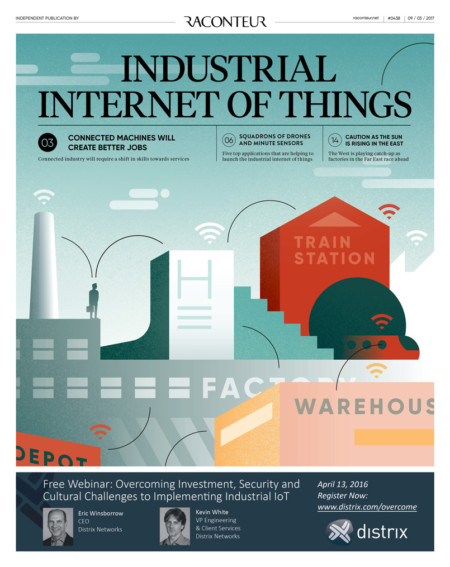 Healthcare systems all over the world are struggling with two fundamental concerns – how to afford the rising cost of delivering care and how to integrate ever-changing new technologies? These twin challenges are intrinsically connected, for emerging technologies offer the promise of making care more affordable as well as more effective. The rewards for successful implementation will be significant, for patients as well as for those responsible for the sustainability of healthcare systems. In healthcare, the internet of things (IoT) is changing the way we think about looking after people. At the heart of this technological revolution is a focus on connectivity. Drug discovery and greater understanding of disease are critical.
- Login to post comments
3-D Printing Turns Nanomachines into Life-Size Workers
By Chenfeng Ke | March 28, 2017
 Nanomachines are tiny molecules – more than 10,000 lined up side by side would be narrower than the diameter of a human hair – that can move when they receive an external stimulus. They can already deliver medication within a body and serve as computer memories at the microscopic level. But as machines go, they haven’t been able to do much physical work – until now. My lab has used nano-sized building blocks to design a smart material that can perform work at a macroscopic scale, visible to the eye. A 3-D-printed lattice cube made out of polymer can lift 15 times its own weight – the equivalent of a human being lifting a car...
- Login to post comments
An Antibiotic-Resistant Superbug Is Silently Spreading through UK Hospitals
Madlen Davies | New Statesman | March 21, 2017
Lying in a hospital bed, four months pregnant, Emily Morris felt only terror. She had caught a urinary tract infection and it was resistant to common antibiotics. Doctors needed to treat it as it could harm the baby, but the only drugs that could work hadn’t been tested on pregnant women before; the risks were unknown. Overwhelmed, Emily and her husband were asked to make a decision. A few hours later, gripping each other’s arms, they decided she should be given the drugs...
- Login to post comments
OpenMRS Google Code-In Student Nji Collins Wins Grand Prize
By Jeff Neiman | March 27, 2017
- Login to post comments
Gathering for Open Science Hardware 2017: Building a Movement
By Andre Maia Chagas, Max Liboiron, Jenny Molloy, Juan Manuel Garcia Arcos and Jeffrey Warren | March 27, 2017
 Without hardware, there is no science. Instruments, reagents, computers, and lab equipment are the platforms for producing systematic knowledge. Innovations from lenses to atomic force microscopes to DNA sequencers to particle accelerators have opened up new fields of knowledge with huge potential impacts for science and society. However, participants in the Gathering for Open Science Hardware, currently taking place at the Innovation Centre, Pontificia Universidad Católica de Chile, argue that limited access to scientific tools impedes the progress and reach of science. Black-box scientific tools block creativity and customization through high mark-ups and proprietary designs, compounded by intellectual property restrictions...
- Login to post comments
Open Source Job Opportunities Grow at Humanitarian Crisis Relief Groups
By Kate Chapman | March 26, 2017
 Typically, when a crisis group or organization is faced with a humanitarian emergency, they tend to focus on what has worked in the past because new solutions need to be tested prior to an emergency. We also see that volunteers for these groups/organizations are usually the first to bring an open source tool or project to the table as a potential solution. With a greater influx of open source tools being used in crisis situations, organizations are realizing the power of open source to allow them to adapt technology quickly in a changing environment and to work together across organizations.
- Login to post comments
Making Personal Health Data Available During an Emergency
By Lee Stevens | March 26, 2017
 If you or your family were injured during a disaster like a hurricane, earthquake or forest fire, wouldn’t you want your health data to be available to first responders and others who are there to provide care? We thought you might, and we are partnering with the State of California to pilot just such a project. Working at the Office of the National Coordinator for Health Information Technology (ONC), we have had the opportunity to leverage investments in health information technology to spur innovation in public health and preparedness...
- Login to post comments
Drugs Are Killing So Many People in Ohio That Cold-Storage Trailers Are Being Used as Morgues
Kristine Phillips | The Washington Post | March 16, 2017
By about 3 p.m. Friday, a county morgue in east Ohio was already full — and more bodies were expected. Rick Walters, an investigator for the Stark County coroner's office, had just left for two death scenes: a suicide and an overdose. From the road, he called the director of the Ohio Emergency Management Agency to ask for help. He needed more space, he explained — specifically, a cold-storage trailer to act as an overflow morgue...
- Login to post comments
3D Printing the Next Five Years by Prof. Joshua Pearce
Joshua Pearce | 3D Printing Industry | March 20, 2017
 3-D printing should have been here 20 years ago. If my generation had had access to 3-D printers in high school, we would be technical wizards by now. Unfortunately, 3-D printing was locked away by patents, which effectively limited access to rapid prototyping to large corporate R&D centers. I am sure the hundreds of thousands of dollars invested in those early machines paid dividends, but they barely scratched the surface of the potential of additive manufacturing. As readers of 3-D Printing Industry know, we are finally starting to see the potential now...
- Login to post comments
Can a 3D Printing Network for VA Hospitals Realize Ambitions for Customized Prosthetics?
Stephanie Baum | MedCity News | March 20, 2017
 Stratasys has established a 3D printing lab network as part of an agreement with Center for Innovation at the Department of Veterans Affairs. The move signals the medtech company’s ambitions to move customized prosthetics into the mainstream of healthcare. The agreement with the Center for Innovation at the Department of Veterans Affairs will make five hospitals part of the initial network in Puget Sound, San Antonio, Albuquerque, Orlando, and Boston...
- Login to post comments
Copyright ©2011-2020 Open Health Marketplace, LLC. All Rights Reserved.