
News
See the following -
The FDA Takes On Mobile Health Apps
The mobile health industry has a problem: It has grown too quickly. Consumers can now download medical apps for at-home monitoring of just about any obscure ailment, and apps for general wellness, diet, and fitness are proliferating... Read More »
- Login to post comments
The Fight for the "Right to Repair"
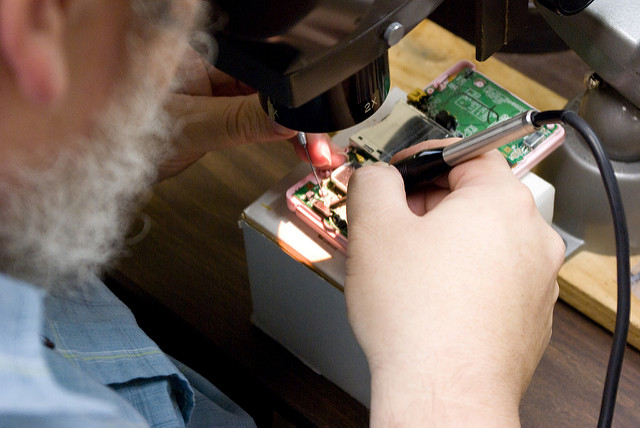 Manufacturers have made it increasingly difficult for individuals or independent repair people to fix electronics. A growing movement is fighting back. Fifty years ago, if your television broke you could bring it to the local electronics shop to be repaired. These days, a broken TV likely means a trip to Best Buy for a new one. Electronics have become harder to fix. This is, in part, because they’ve become more complex. But some of the problem is by design...
- Login to post comments
The First 3D Printed Organ -- A Liver -- Is Expected In 2014
Approximately 18 people die every day waiting for an organ transplant. But that may change someday sooner than you think -- thanks to 3D printing. Read More »
- Login to post comments
The First National Open Access Conference In Uganda
The Consortium of Uganda University Libraries (CUUL) in partnership with EIFL and the Regional Universities Forum for Capacity Building in Agriculture (RUFORUM) organised the first national conference on “Open access (OA), knowledge sharing and sustainable scholarly communication in Uganda” on May 21, 2013 at the Silver Springs Hotel, Kampala. Read More »
- Login to post comments
The Fiscal Consequences Of The Affordable Care Act
The view that comprehensive health care reform must make a substantial positive contribution to repairing the federal fiscal outlook was one of the motivating principles underlying the March, 2010 passage of the Affordable Care Act (ACA). The ACA as enacted falls well short of that standard and would significantly worsen the federal government’s fiscal position relative to previous law. Read More »
- Login to post comments
The Flaws Of Electronic Records
Drexel University's Scot Silverstein is a leading critic of the rapid switch to computerized medical charts, saying the notion that they prevent more mistakes than they cause is not proven. Read More »
- Login to post comments
The FOIA Machine: Software Saves Reporters From Government Hell
They say freedom isn’t free. And that’s certainly true of FOIA requests. Read More »
- Login to post comments
The Forkers Saving Open Source From A Corporate Bear Hug
Open source has long had a strong corporate element to it, perhaps starting in earnest when IBM pledged to spend $1bn on Linux back in 2000. Despite the benefits of corporate funding of open-source software - more money, more source code written - some question whether open source has become too corporate... Read More »
- Login to post comments
The Future According To Megan Smith
Women 2.0 conference keynote speaker and Google[x] VP Megan Smith gives us a glimpse of her 2020 vision — and it’s pretty inspiring. Read More »
- Login to post comments
The Future Of Big Data : Open Source v. Proprietary |#BigDataSV
In last week’s companion to SiliconANGLE’s #BigDataNYC, theCUBE broadcast live from Silicon Valley, highlighting the ongoing maturity of Big Data for 2014 and beyond. John Furrier welcomed theCUBE alumni Bruno Aziza and Rishi Yadev for one of the more interesting conversations centering on the method and business model that will further advance the adoption of Big Data in the Enterprise. Read More »
- Login to post comments
The Future of Connected Medical Devices (Part 2)
Two key chronic and wide-spread health care conditions – cardiac disease and diabetes care – are prime contenders to evolve existing technologies into wireless-enabled devices. Cardiovascular disease is the leading cause of deaths globally. According to the World Health Organization, approximately 17.5 million people died from cardiovascular disease in 2005, or about 30% of all global deaths. In this Huffington Post article, ”The Disease that Will Affect Half the Nation by 2020,” Andrea Pennington points out that diabetes, though not as lethal, affects 27 million people in the United States today and is predicted to affect 50% of Americans by 2020.
- Login to post comments
The Future Of Health Care Access
Traditional health care is a hands-on, brick-and-mortar affair. But across the developing world, a wave of technology-driven innovation signals the emergence of a compelling new model. Read More »
- Login to post comments
The Future of Health Is In #Opendata
This Saturday I had the pleasure of helping organize a hackathon that was put together by the Open State Foundation (HackDeOverheid). The theme was “Open Data, open for business” and took place at a very unique place in Rotterdam – WORM (an institute for avant garde recreation). Read More »
- Login to post comments
The Future Of Linux: Evolving Everywhere
Cemented as a cornerstone of IT, the open source OS presses on in the face of challenges to its ethos and technical prowess Read More »
- Login to post comments
The Future Of Open Access: Why Has Academia Not Embraced The Internet Revolution?
More than any other technology, the web has revolutionized access to the world’s information, putting everything from recipes to encyclopedias to books to news at the fingertips of anyone with an internet connection anywhere on the planet. The web’s role in democratizing access to global information has made it a poster child for the power of technology to advance society. Read More »
- Login to post comments