
GAO Report on Patient Matching: Nothing New Under the Sun
 On January 15, 2019 the US Government Accountability Office (GAO) released a new report to Congress, Health Information Technology: Approaches and Challenges to Electronically Matching Patients' Records across Providers. This report is in response to the mandate in the 21st Century Cures Act for the GAO to study patient matching. To develop this report, GAO reviewed available literature and interviewed more than thirty-five stakeholders (who are not identified) over the course of a year. I have written several blogs and a feature article on patient matching developments in the US. Similarly, this new GAO report is an excellent retrospective on industry efforts over the past several years.
- Login to post comments
2019 International Conference On Disaster Medicine & Hurricane Resiliency
The devastation wrought by powerful hurricanes over the last two years attests to the need to prepare healthcare professionals for emerging crises associated with natural disasters. The International Conference on Disaster Medicine & Hurricane Resiliency brings together physicians, nurses, educators, and other professionals focused on patient care to explore disaster medicine in the context of hurricanes and other severe weather events. Through workshops, plenaries, and panel discussions, attendees will gain essential emergency planning and preparation skills to better understand the role of disaster medicine in effective healthcare management.
- Login to post comments
Lost in the Signal...Is Most Healthcare Spending Being Wasted?
 I finally got around to reading Bryan Caplan's The Case Against Education: Why the Education System Is a Waste of Time and Money. In it, Dr. Caplan, an economics professor at George Mason University and self-avowed libertarian, argues that, aside from basic literacy and numeracy, our educational system serves less to educate and more as a way to signal to employers who might make good employees. Oh, boy did this book make me think about our healthcare system.Dr. Caplan's views on economic signaling are by no means out of the mainstream, although his application of it to education may be. Think of it this way:
- Login to post comments
ONC Releases New NPRM on Interoperability: How Might it Affect Public Health?
On February 11, 2019, the Office of the National Coordinator for Health Information Technology (ONC) released its latest Notice of Proposed Rulemaking (NPRM) to Improve the Interoperability of Health Information. Referred to by some people as the "Information Blocking NPRM," since this was the primary topic anticipated, the document actually covers a host of other topics related to interoperability driven primarily by requirements of the 21st Century Cures Act. Besides the initial text of the NPRM, ONC also released a set of summary slides and fact sheets to help explain the document.
- Login to post comments
Getting started as a GitLab contributor
 GitLab's open culture is one of its strongest assets and the main reason I use GitLab in DevOps transformations. The community edition's code is open source and the paid version makes its source code available for contributions. These are valuable factors rooted in the company culture its CEO has diligently maintained over the years. It doesn't hurt that its tools are great, too. I believe GitLab's sales and marketing team is the best of any company out there. They have included me as a user, customer, and friend over the last few years, and they are genuine and caring people. This was underscored last year when I wanted to contribute a feature, and GitLab's team went to extraordinary lengths to help me succeed. Here's the story of making my first contribution to GitLab.
- Login to post comments
So I Survived HIMSS19…
This was perhaps more of a fete than it initially seems. The conference was massive, with over 40,000 attendees. It centered around a trade show exhibit hall that spanned multiple football fields in length. In some ways, it was so big that I felt somewhat discouraged from attending some educational sessions because they were located so far from where I was hanging out that I could get back and forth in time. So I spent most of my time at the Interoperability Showcase since HLN was participating in two of the use cases: Immunization Integration & CDS, featuring our ICE open source immunization evaluation and forecasting system...
- Login to post comments
Fax Technologies Take Center Stage at HIMSS19 Exhibition
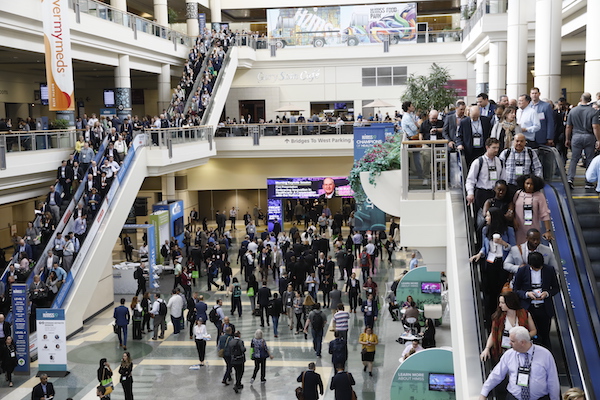 One of the most surprising developments at HIMSS19 is the large number of companies exhibiting their Fax Technologies. Long derided by reporters, health IT consultants, and EHR vendors, fax technologies have been growing in leaps and bounds while EHRs continue to fail to deliver interoperability. Just a couple of years ago faxes were used in around 75% of medical records exchanges. Latest numbers indicate that faxes are now used to exchange more than 85% of medical records. Most people would react in horror to such figures. How could physicians and medical personnel rely on antiquated paper technologies like faxes? The real story to be found on the exhibit floor at the HIMSS 2019 conference is that what we are seeing is a rapid transition to digital fax technologies and platforms. And this transition is taking place because physicians and medical staff have figured out they work!
- The Future Is Open
- Login to post comments
Hack for Humanity 2019
Building on the success of our inaugural hackathon last year, the Humanitarian Innovation Initiative will be organizing the second annual Hack for Humanity event in the spring of 2019. With this humanitarian focused hackathon, we aim to bring together students from across Rhode Island to learn about the most pressing needs in the humanitarian sphere and develop creative ideas for innovative programs or technologies that could help improve the lives of disaster and conflict-affected communities around the world.
- Login to post comments
Open Health Guide to HIMSS19
 The annual gargantuan HIMSS conference is back in Orlando with over 45,000 participants from more than 90 countries. There will be more than 1,300 vendors at the exhibit floor and more than 300 educational sessions. As with the last several conferences, the focus on open source as the key underlying technologies of health information technologies continues to increase. In previous conferences, we have seen the rise of open source technologies, in particular, those related to interoperability such as FHIR and Blockchain. A large number of sessions at HIMSS19 will be focused on another set of technologies powered largely by open source software and design principles such as artificial intelligence (AI), machine learning, and natural language processing.
- The Future Is Open
- Login to post comments
HIMSS19: Open Source Software for Disaster Preparedness and Response
 Although not officially listed as a track at the HIMSS19 conference, there are a series of very important presentations on the use of open source software for disaster preparedness and response. This is a critical topic that we have covered extensively in Open Health News. As we detailed in this article, there was a major failure in being able to provide victims of Hurricane Harvey, as well as Hurricane Irma and Hurricane Maria with access to their medical records. Few emergency medical responders could access their records either. The two success stories that came out of the hurricanes were two open source electronic health record (EHR) systems, OpenEMR and the VA's open source VistA EHR.
- The Future Is Open
- Login to post comments