
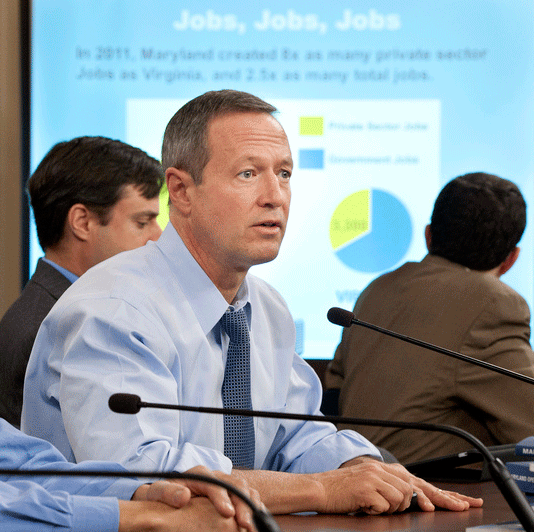
 Amida Technology Solutions, a Maryland-based open source software company, today announced the addition of former Governor Martin J. O’Malley as an Advisor. O’Malley joins distinguished public-sector leaders Michèle Flournoy, General John R. Allen, Sonal Shah, and Scott Gould in guiding Amida in the creation of software and services that will help NGOs, state and local governments, and private companies to solve their most complex data issues.
  Last week, HL7 held it’s annual plenary meeting in Baltimore at the Hyatt Regency...For the FHIR project, our main attention was the ballot. Across the core standard, and multiple implementation guides, we received >800 detailed comments as part of the ballot. This represents a slight increase over the last ballot, but there was a clear change in the focus of the comments – there was a significant drop in the number of comments relating to the infrastructure, and much more focus on the domain content, and it’s applicability to real world problems. This is a clear marker of the growing maturity of the standard. We continue to expect that we’ll publish FHIR release 3 at the end of this year.
 A team from Redgate Software, the Cambridge UK based company behind the world’s leading SQL Server and .NET development tools, is devoting a week to work on the code for an open source biometric fingerprint system that will improve the lives of the poor in the developing world. The system is used by SimPrints, a non profit tech company working with the Gates Foundation and charities like Médecins Sans Frontières to design a low cost biometric scanner that can be deployed in the field. With the scanner, a health worker can swipe a patient’s fingerprint to find and view the correct health records on a mobile device, either online or offline.
 In open source software, end users, decision makers, subject matter experts, and developers from around the world can work together to create great solutions. There are a lot of mature open source projects out there already in the field of humanitarian and development aid, for example: Ushahidi and Sahana in crisis management and information gathering, OpenMRS for medical records, Martus for secure information sharing in places with limited freedom of speech, and Mifos X, an open platform for financial inclusion for people in poor areas where financial services such as savings, payments, and loans are not offered...
 As the year ends and we archive the accomplishments and challenges of 2015, it’s time to think about the year ahead. Will innovative products and services be social, mobile, analytics, and cloud (SMAC)? Will wearables take off? Will clinicians be replaced by Watson? Here are my predictions...Apps will layer on top of transactional systems empowered by FHIR...a better approach is crowdsourcing among clinicians that will result in value-added apps that connect to underlying EHRs via the protocols suggested in the Argonaut Project (FHIR/OAuth/REST). One of our clinicians has already authored a vendor neutral DICOM viewer for images, a patient controlled telehealth app for connecting home devices, and a secure clinical photography upload that bypasses the iPhone camera roll. That’s the future.
 Nextcloud Hub is used in dozens of universities, hospitals, and medical institutes in various ways, aiding in fighting the pandemic. The DICOM viewer app for Nextcloud in particular is used in Brazil in the fight against COVID-19. At the Kiel University of Applied Sciences Nextcloud is used in the development of bluetooth measurement algorithms from the OHIOH.de research team. This is a research project using machine learning and AI to improve the accuracy of Bluetooth-based COVID-19 tracking apps where information is collected through "Bluetooth". The application focuses on research topics to warn and help with required actions in fighting and minimizing the spread of COVID-19.
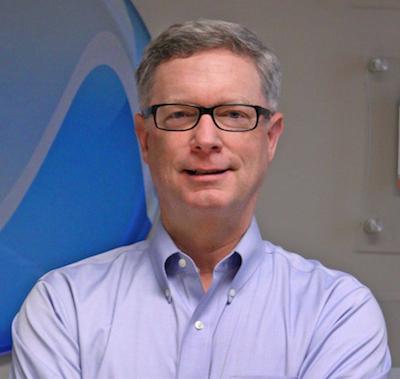 I’m proud to lead a group of intelligent and energetic technology professionals committed to developing a robust healthcare IT system that is (1) easy for clinicians to use, (2) improves patient health and (3) doesn’t bankrupt hospital budgets. We think any sustainable system must have those three key requirements. And how is healthcare doing thus far? The EHRs available today are developing rapidly. Vendors are making frequent and impactful improvements to improve system usability. Clinicians are getting better at maximizing the contribution healthcare IT makes to patient health and safety. It’s not hard to see how healthcare IT can meet the first two requirements and broadly contribute to improved healthcare.
 The 2018 edition of the Pan-African health informatics conference (HELINA) is scheduled from 3rd – 8th December 2018 in Nairobi, Kenya. The conference will be hosted by the Kenya Health Informatics Association (KeHIA) and will focus on how technology is being used to strengthen health systems in the African Region. HELINA conferences have been known to provide a platform for both academia and industry to showcase results of scientific research and industry practice.
  The U.S. Department of Health and Human Services' (HHS) Office of the National Coordinator for Health Information Technology (ONC) today announced $100,000 in total awards to six winners of the Synthetic Health Data Challenge (Challenge). Synthetic health data (i.e., data that is artificially created to mimic real-world data), is important to researchers, health IT developers, and informaticians, among others, who need data to test new ideas until access to secure and actual clinical data is available.
 The Department of Health and Humans Services’ Office of the National Coordinator for Health Information Technology (ONC) today announced the Phase 2 winners of the Move Health Data Forward Challenge. Winning submissions will now move on to the challenge’s last phase to develop applications that will allow individuals to share their personal health information safely and securely with their health care providers, family members or other caregivers...
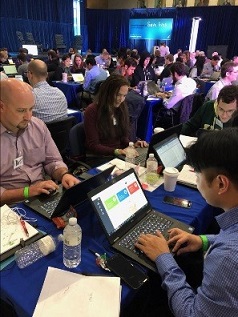 On December 6 and 7, HHS hosted a first-of-its-kind two-day Code-a-Thon to help turn data into lifesaving solutions to the opioid epidemic. Fifty teams, comprised of three to five members of computer programmers, public health advocates, and innovators worked for over 24 hours to create data-driven solutions that can have immediate and practical impact on the opioid crisis. “HHS’ code-a-thon was a major step forward in the efforts to use data to address the opioid crisis,” said Acting HHS Secretary Eric Hargan. “The innovative ideas developed today could turn into tomorrow’s solutions as we work to combat the scourge of opioid addiction sweeping the nation. On behalf of the administration, I commend all of our technology partners and the HHS staff for their hard work on this unprecedented event.”