
 Health care needs a better business model. HHS reports that U.S. health care spending will surpass $10,000 per person this year, will grow almost 6% annually for the foreseeable future, and will consume over 20% of GDP by 2025. About half of our spending goes for labor costs, with health care employment remaining one of the "bright spots" in our economy. Indeed, health care jobs continued to soar even when the economy tanked in our most recent recession. Despite that steady growth, we continue to talk about a physician shortage, especially for primary care. Medical school enrollment is at new highs, yet it is not projected to dent the demand...
Feature Articles
The Open Patient: Advocating for Open Access to Medical Data
By Rikki Endsley | July 26, 2016
 Steven Keating had always been interested in data and learning about things, which is why he volunteered to do a research scan when he was a student. The scan revealed an abnormality. In 2014, the abnormality had grown into a massive tumor. Soon he learned that there were many barriers keeping him from accessing his own data. "And that's what I've been sharing, which is this question: How come as a patient we're last in line for our own data? How come my doctors and my university researchers can see my tumor genome and I can't?"
Do We Really Need More Doctors? How About Trying to Have Healthier Folks?
By Kim Bellard | July 25, 2016
How I Use Linux for Theoretical Physics
By Jonas Hegemann | July 29, 2016
 In 2008, I started studying physics and got in contact with Linux, since a bunch of people used it for data analysis and simulations. Comprehension came fast and easy with such people around, and I was strongly encouraged to get things done with Linux. I installed Ubuntu on my notebook, and soon got familiar with Bash and the standard tools. After some years I turned to theoretical physics. While I was writing my master's thesis I gained access to a workstation running Scientific Linux, and a cluster system with a few hundred cores. I was impressed that each of my peers had implemented his own customized workflow, and that it was actually possible to work entirely with the keyboard, which is inconceivable for a Windows user...
Preventing the Next Heartbleed and Making FOSS More Secure
By Mark Bohannon | July 29, 2016
 David Wheeler is a long-time leader in advising and working with the U.S. government on issues related to open source software. His personal webpage is a frequently cited source on open standards, open source software, and computer security. David is leading a new project, the CII Best Practices Badging project, which is part of the Linux Foundation's Core Infrastructure Initiative (CII) for strengthening the security of open source software. In this interview he talks about what it means for both government and other users...
Peer Learning Helps Tanzania Reach New Ground with Open Data
By Tom Sasse | July 30, 2016
 When we introduced Tanzanian open data officials to their UK counterparts they shared home truths about problems, gaining new perspective and inspiration to engage users, communicate more and seek support from those who can help. Learning from peers is essential to building momentum behind new open data programmes. As part of our work with the Tanzanian government we were delighted to facilitate their meeting with key figures from government, NGOs, businesses, NGOs and startups in the UK, during a London Study Tour...
Halamka Discusses Three Disruptive Care Coordination Innovations In Use at Beth Israel
By John D. Halamka, MD | July 20, 2016
 Would you buy an iPhone if the only apps that ran on it were written by Apple? Maybe, but the functionality would not be very diverse. The same can be said of EHRs. Athena, Cerner, Epic, Meditech, and self developed EHRs such as BIDMC’s webOMR are purpose-built transaction engines for capturing data. However, it is impossible for any single vendor to provide all the innovation required by the marketplace to support new models of care I’m a strong believer in the concept of third party modules that layer on top of traditional EHRs in the same way that apps run in the iPhone ecosystem...
Could Pokémon Go Help Fix Healthcare and Lead to Usable EHRs?
By Kim Bellard | July 15, 2016
However promising gamification in health care may be, it is the AR that may well hold the most promise for health care. Google was not wrong to pursue Google Glass, just premature. Pokémon Go may be signaling that we're now finally ready for AR, and that it will be consumers as well as professionals who can benefit from it. The potential uses in health care are virtually endless, but here are a few examples...Ever feel like your doctor spends too much time staring at your chart or a screen? Instead of looking there for information about you, how much better would it be if he/she was looking at you, with AR notations for key information about you?...
How Drupal Can Save Taxpayers' Time and Money
By OpenSource.com | July 14, 2016
 Providing web services for the government of one of the most populous U.S. states (Georgia) is no small task, but it's made a bit easier thanks to Drupal, open source software, and the work of Kendra Skeene and the GeorgiaGov Interactive team. In her lightning talk at Great Wide Open 2016, Skeene explains the role Drupal and open source software play in the Georgia's efforts to save taxpayer time and money...
Do We Need More or Less Healthcare IT Regulation and Legislation?
By John D. Halamka, MD | July 13, 2016
Just as I clarified last week in my post about Certification, the answer to the question “do we need more or less healthcare IT regulation and legislation” is that we need the right amount of the right regulations/legislation. Sometimes when clinicians prescribe medication, although it does therapeutic good, it creates side effects which need to be addressed by changing a dose or by adding additional medications. Such is the case with HITECH. It was generally good medicine, but now that we’ve seen the side effects on workflow, clinician burden, and efficiency, there needs to be a dose adjustment...
The Most Important Health Care Jobs of the Future
By Kim Bellard | July 9, 2016
Fast Company ran an interesting article The Most Important Design Jobs of the Future, predicting 18 of the most important design jobs of the future (at least 3 to 5 years out). A couple of them were in health care, and arguably all of them would have some impact on health care, but I thought it might be fun to do a similar list specific to health care, and not limited to design. Let's hope no one comes back in a few years to show how wrong I was. I'll skip the usual suspects -- e.g., doctors, nurses, pharmacists. Yes, those jobs will (almost) certainly still be around, but they may not be central as they are today. And those jobs will evolve in ways that reflect the trends illustrated by the jobs I list...
Europeans Joining Forces to Promote Open Source Software in Healthcare
By Gijs Hillenius | July 11, 2016
 Belgian, British and German advocates of open source in healthcare want to join efforts, hoping to raise interest, and to strengthen the network of healthcare software specialists. A conference is tentatively being planned in London (UK) early next year. “Hospitals and other healthcare organizations, medical specialists and general practitioners are reluctant to adopt open source software”, says Etienne Saliez, a Belgian retired medical IT systems specialist. “What is needed is a strong network of professional support services providers of open source solutions” he adds.
When Linux Is the Face of Kindness
By Phil Shapiro | September 7, 2016
 My late father, Lou Shapiro, was an early leader of UNICEF, so relief work was baked into the genetics of my family. His work was centered on emergency relief for the survivors of earthquakes and other natural disasters. Whenever there was an earthquake in the world, I knew dad would be coming home late from work—and I was so proud that some family experiencing trauma would be sleeping in a dry tent, with warm blankets and clean water, because of my dad's work...
An Alternative Proposal for Certification
By John D. Halamka, MD | July 6, 2016
Some have suggested that my comments over the past few months about the Meaningful Use program, MACRA/MIPS, and Certification imply that we should just give up - throw out the baby with the bath water. That’s not what I’ve written.
Here’s a clarification. I believe MACRA/MIPS is the right trajectory - create a set of desirable policy outcomes, then enable clinicians to choose technology, quality measures, and process improvements that are relevant to their practice...
Patents: The Next Open Access Fight
By Elliot Harmon | July 29, 2016
 There’s been a lot of talk lately about the state of publicly funded research. Many, including EFF, have long called on Congress to pass a law requiring that publicly funded research be made available to the public. With strong support for FASTR (the Fair Access to Science and Technology Research Act) in both parties, Vice-President Biden making open access a major component of his Cancer Moonshot initiative, and presumptive presidential nominee Hillary Clinton including access to research in her platform, signs are looking good that Congress will finally pass an open access mandate. It’s just a matter of when...
Linux with ADRIANE Provide a Simple and Usable Menu System for Blind Computer Users
By Seth Kenlon | July 5, 2016
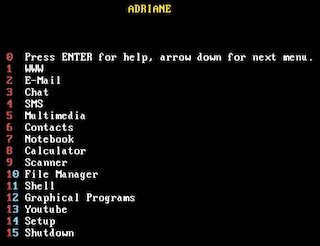 ADRIANE is a great interface with a solid plan for design and functionality. In a way, it reduces a computer down to a minimalist device tuned for the most common everyday tasks, so it might not be the ideal interface for power users (possibly an Emacspeak solution would be better for such users), but the important thing is that it makes the computer easy to use, and tends to keep the user informed every step of the way. It's easy to try, and easy to demo, and Knoppix itself is a useful disc to have around, so if you have any interest in low-vision computer usage or in Linux in general, try Knoppix and ADRIANE...
Copyright ©2011-2020 Open Health Marketplace, LLC. All Rights Reserved.